Agentic Workflows:
Intelligent automation for modern companies
Agentic Workflows take AI-powered automation to a new level.
Instead of executing static rules, AI agents act independently. This redefines decision-making for companies.
How do agentic workflows work in cnips?
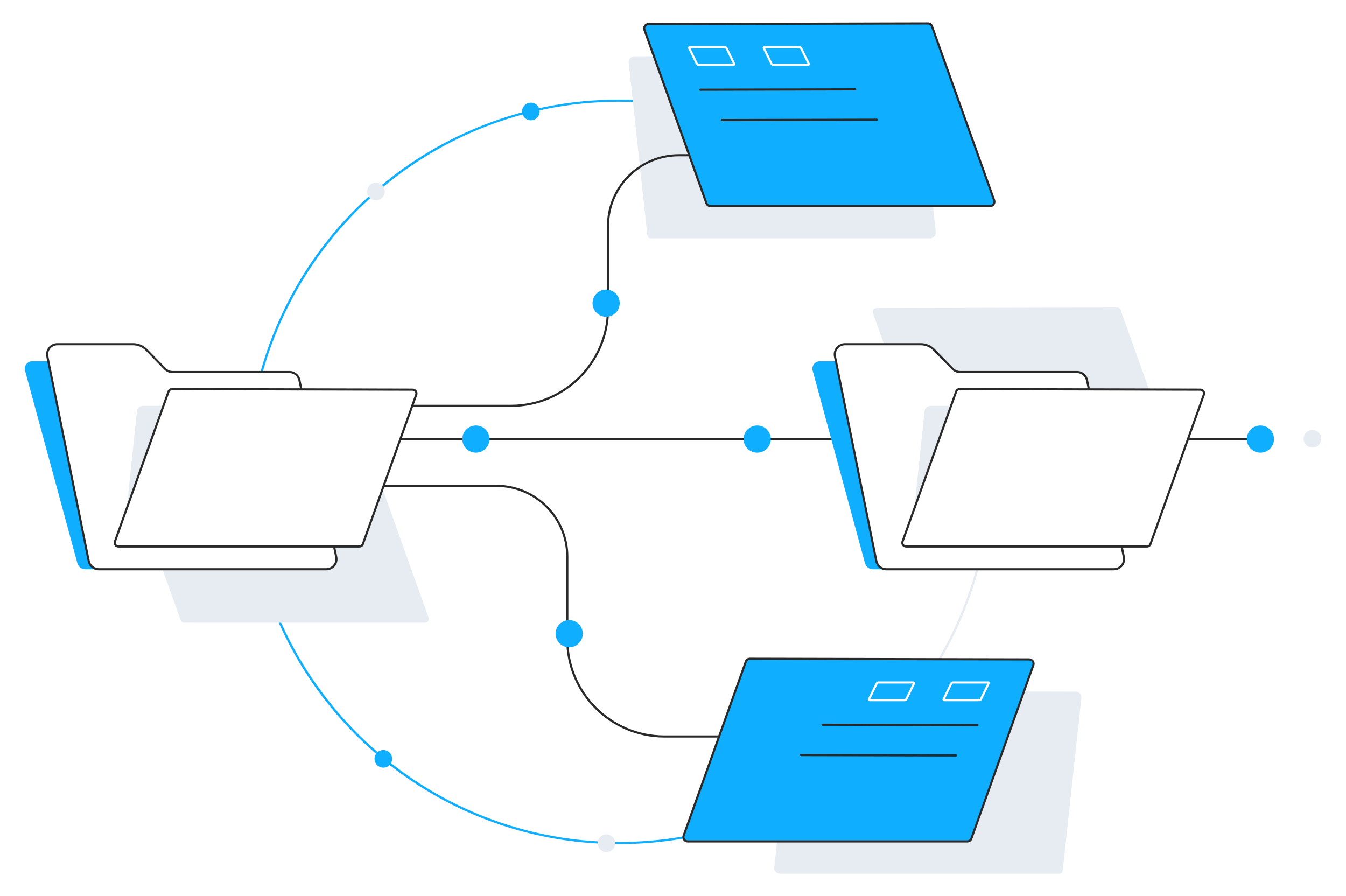
cnips extends its digitally sovereign iPaaS platform with AI agents that autonomously take over tasks, interact with systems, and control workflows in real time. Unlike traditional workflows or chatbots, agent-based processes do not work sequentially, but rather in a goal-oriented, dynamic, and adaptive manner. For companies, AI agents mean fewer manual interventions, more efficient business processes, and automation where complex decisions and human action were previously necessary.
This is how an agent-based workflow works in cnips:

Goal definition
An agent is assigned a clear goal, such as “resolve a customer request,” “validate a data record,” or “update delivery status.”

Context analysis
The agent evaluates available data, access rights, access context, and real-time information.
Planning & actions
Based on AI (such as LLMs or reasoning models), rules, and APIs, the agent determines the required steps and executes them autonomously.

Interaction with systems
Via the cnips platform, the agent retrieves data, triggers APIs, adjusts processes, or orchestrates additional workflows.

Learning & optimization
Through recurring patterns and training, agent decisions improve over time.

The result
Workflows that adapt instead of remaining static.
Benefits of agentic workflows for companies
Agentic workflows are not just a “better chatbot”, but a new automation paradigm that delivers measurable value and real efficiency gains.
The key benefits of agent-based workflows include:
Automation of complex business processes
Agents take over tasks that previously required human judgement, including context evaluation, rule validation, and API interaction.
Adaptive decision-making in real-time
Powered by real-time data and AI, agents make instant decisions and scale automation across systems and environments.
Fewer errors, more control
Intelligent decision-path analysis reduces process errors and makes workflows more secure and traceable.
Scalability without additional effort
Workflows scale automatically without the need to constantly adjust rules or workflows manually.
Seamless integration across the entire platform
Integration with cnips features such as pipelines, APIs, FaaS, approvals, and data integrations creates a fully automated ecosystem.
Efficiency gains through autonomous AI agents
Tasks and processes are automated in a context-aware manner, freeing up resources and accelerating operational execution. At the same time, agents dynamically adapt to business goals.
What other features does cnips offer?
With cnips, enterprises also benefit from the following powerful features:

Pipelines for ETL/ELT data integration

FaaS (Function as a Service) for serverless logic

Approvals for employees in sensitive processes
Connectors & APIs for connecting any application
Transformations for data processing

Workspaces for multi-environment setup & teams
Centralized configuration & monitoring
Multi-tenancy for enterprise-grade structures
Typical use cases for companies
Agentic workflows open up new possibilities for atomation and development, especially in scenarios that previously required human decision-making, contextual understanding or multiple systems. By combining intelligent language models, rules APIs. and real-time data, agents support the development and orchestration of a wide range of business processes.
These range form simple routine tasks to decision-making and complex workflows.

Automated handling of customer requests
Agents analyze incoming tickets, prioritize them, gather missing information, and resolve simple requests fully automatically without manual intervention.
Intelligent data validation & data maintenance
Agentic workflows validate data records, clean information, and update systems across multiple applications. Ideal for CRM, ERP or compliance processes.

Real-time supply chain optimization
Agents react to inventory changes, delivery status updates or sensor data and automatically trigger actions: From reordering to quality checks.

Automated IT & DevOps orchestration
From incident analysis and log evaluation to triggering API-based workflows, agents significantly accelerate IT operations and support processes.

Sales & marketing automation
The cnips functionality can personalize offers, analyze leads, update customer segments, and trigger automated campaigns across multiple touchpoints.
Compliance & governance monitoring
cnips validates policies, detects violations, performs automated checks, and documents deviations – making it especially suitable for regulated industries.
Digital sovereignty starts with control over your agents and data
With cnips, companies retain full control over their agent-based workflows and data at all times. Our iPaaS platform is operated exclusively in Germany and the EU – ensuring that all AI-powered agents, data, and interactions remain within a sovereign, legally and secure environment.
As a result, agentic workflows are not only efficient and context-aware, but also GDPR-compliant and independent of non-European providers. Companies benefit from secure automation, transparent rules and a trusted foundation for scalable AI-driven processes.

Intelligently connect systems with agentic workflows
cnips connects systems, data sources, and applications on a unified automation platform – addressing operational challenges such as systems ilos, manual handovers, and a lack of transparency.
Test cnips and experience how AI agents elevate your processes to the next level.
FAQs: Agentic workflows
What are agent-based workflows?
Agentic workflows are AI-powered, agent-based workflows that autonomously execute tasks, make decisions, and interact with systems. They operate in a goal-oriented rather than rule-based way and enable intelligent automation of complex processes.
Agentic workflows vs. chatbots – what’s the difference?
Chatbots are dialogue-driven tools. Agents act autonomously, plan steps, access APIs, and automate complete workflows. In short: chatbots answer questions, agents solve tasks.
Generative AI vs. agentic AI – what’s the difference?
Generative AI creates content such as text or code. Agentic AI executes actions, orchestrates processes, evaluates context, and makes decisions. In enterprises, agent-based workflows represent the next step toward autonomous process automation and the logical evolution of Robotic Process Automation (RPA).
How will agent-based workflows change enterprises in the coming years?
They reduce manual work, automate end-to-end processes, and increase efficiency across entire departments: From support and operations to logistics, finance, and IT. Companies benefit from faster response times, fewer errors, and scalable workflows.
Can cnips agentic workflows be tested?
Yes. Companies can test workflows in cnips within a demo environment and explore realistic scenarios. Book a demo now and experience agents live.