Digital sovereignty for companies
Mantain control. Reduce dependencies. Act in a future-proof manner.

Data sovereignty:
Why is independence so crucial?
Data is the strategic raw material of the digital economy. Companies who do not have control over their data flows, access, and dependencies will lose their freedom of choice, security, and resilience in the long term.
A large proportion of European companies still rely on non-European providers for their IT infrastructure.
This results in:
Increasing dependence on cloud and software companies
Limited transparency regarding data processing and AI usage
Growing risks related to data protection, cybersecurity, and regulatory requirements
Digital sovereignty means:
cnips provides decoupling right here: The iPaaS platform connects, orchestrates, and automates. Systems remain sovereign and data stays in its original location.
How companies can reach
digital sovereignty
Digital sovereignty does not come about through a single tool, but through a clear strategy:
Consciously managing dependencies
Not every dependency is bad; the key is to be aware of them transparently. Open standards, modular architectures, and interoperable solutions reduce lock-in risks and open up scope for action.
Connect systems without relinquishing control
Digital sovereignty often fails due to fragmented system landscapes. cnips connects existing software, cloud services, AI services, and legacy systems without the need for central data storage.
Confidently manage identities and access
Digital sovereignty begins with identities. In combination with cidaas CIAM/IAM, companies retain full control over:
- Users, roles and access
- APIs, systems, and processes
- Customer and employee identities
Sovereign infrastructure and cloud strategy
Is your current software digitally sovereign? These questions are becoming increasingly important for companies:
cnips is operated exclusively in Germany and the EU and therefore fits seamlessly into sovereign cloud and on-premises strategies.
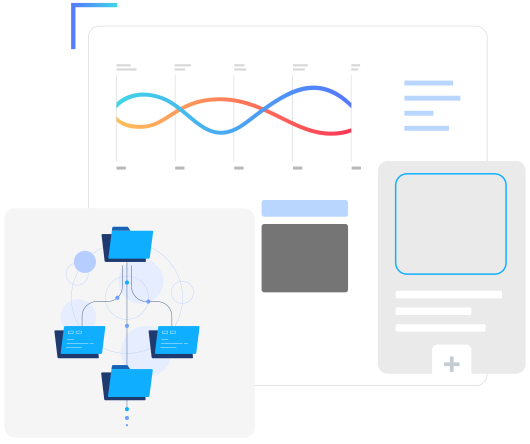
This is what a digitally sovereign architecture with cnips can look like
A digitally sovereign architecture with cnips follows the principle: Connect instead of relocate. Existing applications, data sources, APIs, and AI services remain in their respective environments. cnips orchestrates the interaction between them without creating data silos.
Through open standards, modular connectors, and automated workflows, cnips manages processes across systems in a transparent and traceable manner. Companies define for themselves which data flows, when it is processed, and which systems are allowed to interact with each other.
This creates transparency regarding data flows, access, and dependencies – a key prerequisite for digital sovereignty. Operating exclusively in Germany and the EU, cnips integrates seamlessly into sovereign cloud, hybrid, or on-premises strategies.
The architecture remains extensible, scalable, and independent of individual platform providers. This creates a robust foundation for automation, AI deployment, and future digital business models.
For which companies is
cnips suitable?
cnips is suitable for companies that want to efficiently connect, automate, and future-proof complex system landscapes. Companies with multiple applications, cloud and on-premises environments, or high requirement for scalability, security, and digital sovereignty benefit particularly from this solution.
The iPaaS cnips is ideal for:
Large companies and corporations that centrally orchestrate complex data flows, APIs, and business processes
Regulated industries such as manufacturing, finance, retail, or the public sector with high requirements for compliance and data sovereignty

Companies with European sovereignty requirements that want to avoid dependencies outside Europe
Thanks to its modular architecture, no-code low-code approaches and agent-based workflows, cnips adapts flexibly to different levels of maturity, use cases, and growth phases: From initial integration to a company-wide automation platform.
The future of digital sovereignty
for businesses
In the coming years, digital sovereignty will become a competitive factor:
Artificial intelligence, automation, and data-driven processes are on the rise
Regulatory requirements are increasing (GDPR, NIS2, DORA, KRITIS)
Cyber risks are becoming more complex
Companies that invest in sovereign platforms, open technologies, and resilient IT architectures today are securing their long-term ability to act.
cnips plays a central role in this: as an integration center, it connects systems, AI applications, and key technologies securely, flexibly, and independently.
FAQs –
Digital sovereignty for companies
What is digital sovereignty?
Digital sovereignty describes the ability of companies to make their own decisions about their digital technologies, data, and processes without uncontrolled dependence on individual providers, states, or platforms.
What are the advantages of an iPaaS solution for digital sovereignty?
An iPaaS such as cnips promotes vendor independence, decouples systems and data flows, enables flexible, sovereign IT architectures, and securely connects cloud, on-premises, and AI technologies.
How does cnips support GDPR, NIS2, and European compliance requirements?
cnips operates exclusively in Germany and the EU and processes data in compliance with the GDPR within European jurisdictions. The platform supports governance, security, and control mechanisms that help companies implement NIS2 and compliance requirements.
How does cnips avoid dependencies on hyperscalers or US providers?
cnips relies on open standards, modular architecture, and European infrastructure. This allows companies to remain independent of individual cloud providers or proprietary platforms and retain full control over their integration landscape.
How complex is implementation for existing systems?
Implementation is streamlined and can be carried out step by step. Thanks to connectors, APIs, and no-code/low-code approaches, existing systems can be quickly connected without fundamentally changing existing architectures.
How does cnips scale with growing requirements?
cnips is cloud-based and horizontally scalable. New integrations, workflows, or data flows can be added at any time without affecting the existing infrastructure.
Does cnips store data?
cnips does not store any technical company data. The platform processes and orchestrates data flows between systems and transmits information securely without acting as a data storage device itself.