What is iPaaS software – and why does your company need it?
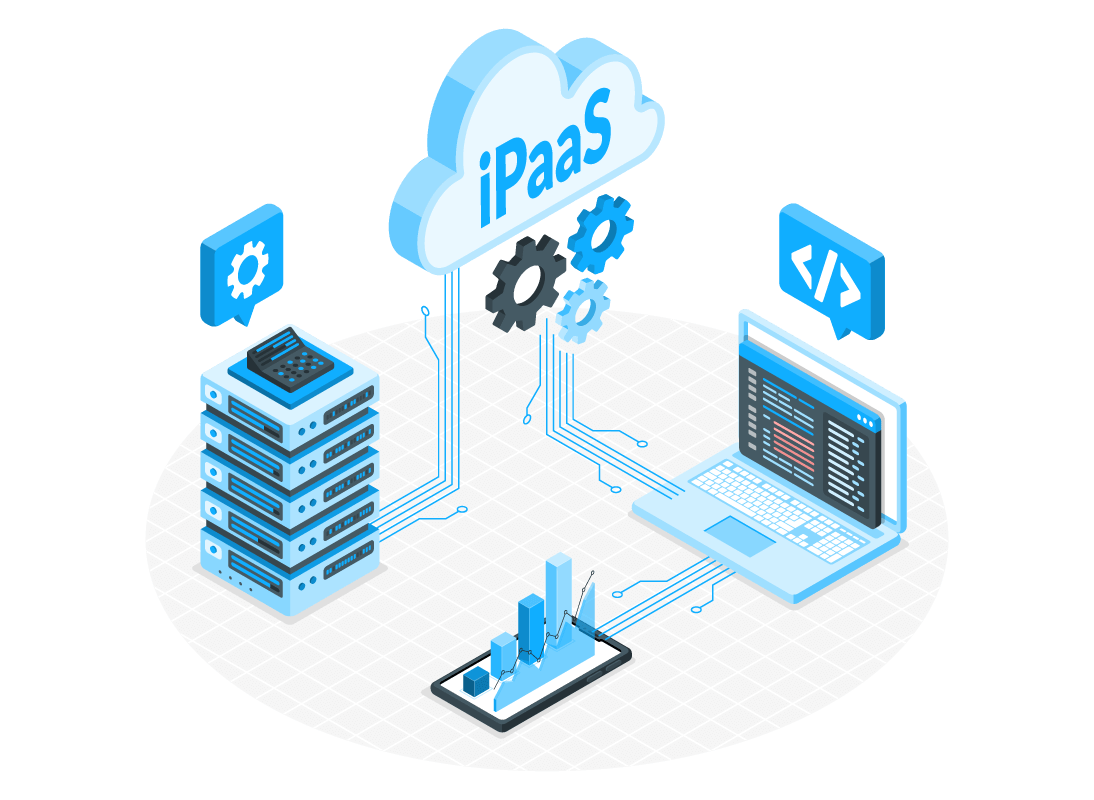
This is exactly where iPaaS comes into play – an Integration-platform-as-a-service like cnips that connects all systems in a standardized way and makes information available company-wide.
In this article, we explain what is behind the term iPaaS, how such platforms work and why they are indispensable for modern companies today.
What is iPaaS software? – The simple explanation
iPaaS stands for “Integration-platform-as-a-Service”. This is a cloud-based platform that enables companies to connect different software solutions and data sources with each other – as a cloud-based solution, the often costly maintenance and operating costs are eliminated. Solutions that are currently based on scripts, cronjobs and a lot of attention are given a modern environment. Automated monitoring of the “scripts” and graphical user interfaces reduce the administrative effort and allow processes to be professionally automated even without specialist knowledge.
Additional approaches with low-code and no-code as well as ready-made function modules increase security almost incidentally, without the need for complex programming or manual data transfer.
👉 What is iPaaS? Think of iPaaS as a digital interpreter that lets your software systems talk to each other in real time.
How does an iPaaS solution work?
iPaaS platforms such as cnips offer a graphical user interface on which you can model processes using drag & drop. You select the applications that are to be connected (e.g. HubSpot, Personio, DATEV and so on), define the rules according to your needs – and the automation is up and running.
Typical functions of modern iPaaS systems
Typical features of modern iPaaS software include the following:
- Low-code/no-code interface construction
- Automated data flows
- Real-time monitoring & error management
- Scalability for small to large workflows
- Data backup and compliance via API keys
- Approvals (e.g. approvals of integration and data flows)
- As well as agentic workflows (agent-based process automation)
SaaS vs. iPaaS
SaaS delivers a ready-made software solution (e.g. CRM or HR) via the cloud. iPaaS is the integration platform that connects these software applications and systems, syncronizes data, and automates workflows. Technically speaking, iPaaS software is based on the cloud, making it a modern middleware or platform for integration.
iPaaS vs. ESB
An ESB (Enterprise Service Bus) is typically anchored in on-premise architectures and strongly transaction- and service-oriented. An iPaaS is a cloud-based integration platform that is optimized for SaaS, APIs, and events, enabling rapid implementation via connectors. ESBs are often suitable for established, complex legacy landscapes and long release cycles. iPaaS on the other hand, scores points for agile projects, hybrid cloud scenarios, and modern automation.
iPaaS vs. PaaS
PaaS (Platform-as-a-Service) provides a development and runtime environment for creating applications, such as runtimes, databases, DevOps, and infrastructure abstraction. iPaaS on the other hand, focuses on integration, which includes the integration of systems, the modeling of data flows, and the management of processes.
What are some possible use cases for an iPaaS software?
Typical uses cases range from data integration between ERP, CRM, and HR systems to the automation of entire business processes in real time. Companies use it to connect SaaS software applications and on-premise systems via APIs and connectors, orchestrate workflows, and secure data flow through monitoring.
Common scenarios include e-commerce order processing, lead synchronization between marketing and sales, invoice and payment processing, master data harmonization, and event-driven integration of new applications into existing architecture. All of these data flows run in the cloud via a central platform.
Why does your company need an iPaaS software?
The answer is simple: Because manual processes cost time, money and nerves.
1. Reduction of operating expenses
Modern iPaaS solutions allow the integration of code snippets, comparable to scripts, but also offer you the convenience of taking over the operating processes and monitoring the execution – with automatic alerting if desired.
2. Increase efficiency
Automate routine tasks and gain time for the essentials. No more duplicate data maintenance – everything runs centrally and synchronized.
3. Flexibility for growth
New tools in the company? With iPaaS, integrations are created quickly and data flows are connected without overloading your IT department.
4. Security & compliance
Integration and central control of all data flows offer maximum control – the main focus here is on automated monitoring of the interfaces. Function modules for OAuth integration and protection using API keys ensure high security standards.
5. Reduced IT dependency
Even specialist departments can automate processes – without in-depth developer knowledge. This relieves your IT in the long term.
Which industries profit the most from an iPaaS software?
Companies of all sizes benefit from systems that “talk to each other” and constantly exchange data. Industries with many heterogeneous systems, high process cycles, and hybrid cloud scenarios benefit from this integration platform.
These include companies in manufacturing (bill of material), e-commerce and retail (e.g. inventory, orders, fulfillment), financial services (e.g. rule- and interface-driven processes), healthcare (especially sensitive data integration), logistics (real-time tracking), and professional services (liek project-related workflows).
In these areas, iPaaS solutions create measurable benefits: Less friction between technologies, faster development of new integrations, robust, scalability, reliable data manegement, and better transparency in administration.
iPaaS as the key to the digital future
Whether you want to automate your business processes, connect tools more efficiently or drive digital transformation – iPaaS is the enabler.
Platforms like cnips – iPaaS offer exactly the flexibility, speed and user-friendliness that modern companies need today.

