
Low code business process automation: Rethinking efficiency with cnips
Digital business models rarely fail because of a lack of ideas.
They fail because of slow processes. In many organizations, workflows are still coordinated manually: Emails are forwarded, Excel sheets are maintained, approvals are handled by phone. With every new application and system, complexity and coordination effort increase.
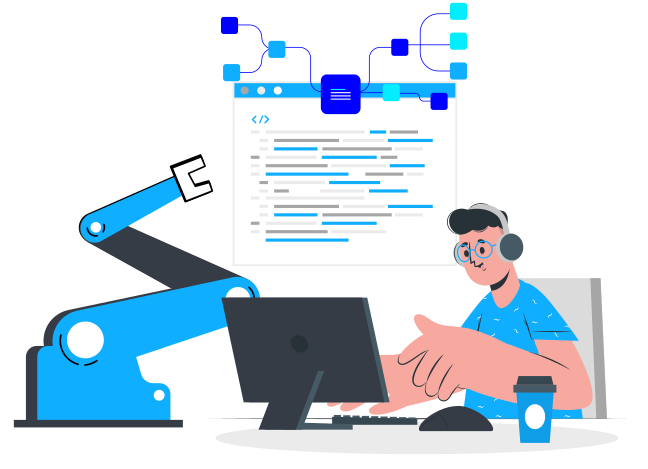
Low code business process automation means structuring recurring workflows, visually modeling processes, and enabling system integration without traditional programming. The result is process automation that not only increases efficiency but also scales sustainably.
Why manual processes become a risk
Today, companies work with a wide range of platforms, applications, and software solutions. CRM, ERP, identity systems, ticketing platforms, and other tools generate data every day. However, these systems are often not intelligently connected.
This leads to several challenges:
- Media breaks between systems
- Error-prone manual entries
- Delayed approvals
- Lack of transparency across workflows
- High coordination effort between business departments and IT
Especially when dealing with complex requirements or regulatory obligations, additional challenges arise. Without structured automation, compliance, documentation, and audit trails are difficult to ensure.
Which business processes can be automated with low code?
This raises an important question for companies: Which processes are actually suitable for low code automation? Recurring, rule-based workflows with clear decision points are particularly well suited for automation.
These include:
- Onboarding processes for employees or customers
- Approval and authorization workflows
- Data synchronization between ERP and CRM systems
- Identity and verification processes
- Contract and compliance checks
- Ticketing and support workflows
What matters is not the complexity of a single step, but the number of systems and departments involved. This is exactly where low-code process automation unlocks its full potential.
How does low code business process automation work?
A common question is whether business departments need in-depth programming knowledge to automate processes with low code.
The answer is no. Modern low-code platforms allow workflows to be created visually. Logic is modeled using graphical building blocks rather than manually written code. IT teams still maintain control over security, integration, and governance.
The result is improved collaboration between business units and IT without shadow IT or isolated tools.
Practical example of an automated process
A typical digital process could look like this:
- A user registers within an application.
- An event automatically triggers a workflow.
- An identity verification process is initiated.
- Relevant data is transferred to ERP and CRM systems.
- An approval is checked.
→ The user automatically receives confirmation.
What previously required multiple manual tasks now runs automatically within seconds, fully documented and transparent.
Is low code business process automation secure?
For organizations with strict compliance requirements, security is a central concern. Low-code automation is secure when it is implemented in a structured way.
Modern platforms provide:
- Role-based access control
- Documented process steps
- API security
- Transparent logs
- Clear governance structures
Automation does not mean losing control. On the contrary, it increases traceability and accountability across processes.
How long does the implementation take?
Compared to traditional development, low code significantly reduces implementation time. While conventional programming can take months, many business processes can be modeled and deployed within a few weeks.
The advantages are clear:
- Faster project delivery
- Reduced resource allocation
- Greater flexibility when adapting to new requirements
The Process optimization becomes continuous rather than a one-time IT initiative.
Is low code suitable for complex enterprises?
Another common concern is scalability. In fact, larger enterprises with complex IT landscapes benefit particularly from a structured low-code strategy.
The more systems, departments, and data flows involved, the more important centralized orchestration becomes. Low-code platforms enable organizations to model and adapt complex workflows without replacing existing systems.
Are there any challenges with isolated automation tools?
Many companies begin with individual automation tools. However, this often leads to:
- Tool sprawl
- Uncoordinated integrations
- Security risks
- Lack of transparency
Automation should therefore be implemented strategically as part of an overarching architecture, not as an isolated solution.
Orchestrating business processes with a low code platform
cnips enables organizations to automate business processes with low code without creating additional data silos. The platform follows an API-first approach, orchestrates processes in an event-driven manner, and does not store any data itself.
Workflows can be created visually, flexibly adapted, and executed across systems. This results in structured automation that combines security, efficiency, and digital sovereignty.
Instead of isolated tools, companies establish a central orchestration layer for all relevant business processes.
Conclusion: Automating business processes with low code as a strategic lever?
Organizations that automate their business processes with low code reduce manual tasks, increase transparency, and improve collaboration between employees and teams.
Low code automation is not a replacement for professional development, now or in the future. It is a smart approach to process optimization. When implemented correctly, it becomes an enabler for sustainable success, scalable solutions, and a future-proof IT architecture.
Would you like to automate your business processes intelligently? Our experts are happy to discuss your options with you. Schedule a free consultation with us today!
More infos about technology, AI and additional capabilities
Learn more about our iPaaS features here.

